
In modern Japan, the practice of “Goshuin Meguri,” or pilgrimage to collect temple and shrine stamps, is a popular way to explore history, appreciate art, and engage in self-reflection. Without a prescribed set of destinations, this journey is, by its nature, an “endless journey.” Yet, for pilgrims who have spent years visiting countless sacred sites, the moment a Goshuin-cho (stamp book) becomes full marks a significant spiritual milestone—a desire for a virtual “final chapter.”
This isn’t merely about completing a collection. It’s the manifestation of a deep spiritual need to find a ceremonial endpoint, a place to summarize the experiences gained on the journey and report one’s gratitude and resolutions to the gods and buddhas. This article explores the concept of this “final chapter” and considers the ultimate destinations worthy of concluding a sacred pilgrimage.
“Ketsugan” vs. “Mangan”: The Philosophy of Completion

To understand the end of a pilgrimage, two key terms are essential: “Ketsugan” and “Mangan.”
– **Ketsugan (結願)**: This refers to the physical completion of a set pilgrimage route, such as the Shikoku 88 Temple Pilgrimage. It signifies an *active completion*.
– **Mangan (満願)**: This signifies the complete fulfillment of the wish or vow made at the start of the pilgrimage. It symbolizes a *spiritual fulfillment and transformation* that goes beyond formal completion.
The “final chapter” in a modern Goshuin journey, which lacks a rigid route, aligns more closely with the concept of “Mangan.” The very act of setting a destination to end a self-directed journey carries the spiritual weight of reporting one’s maturity to the divine and fulfilling a personal vow.
Principles for Choosing the Ultimate Destination

The final destination for a Goshuin pilgrimage must be a place capable of validating the diverse experiences and beliefs of the individual, one with the gravitas to certify the journey’s completion. We propose three guiding principles for this selection:
1. Authority: It must possess the highest spiritual authority, befitting the certification of a pilgrimage’s accomplishment.
2. Universality: It must have an inclusive nature that transcends the boundaries of Shintoism and Buddhism.
3. Perpetuity: It should symbolize that the end of one journey is the beginning of a new spiritual practice.
Based on these principles, we will analyze three sacred sites as leading candidates.
Top 3 Candidates for Your Final Destination
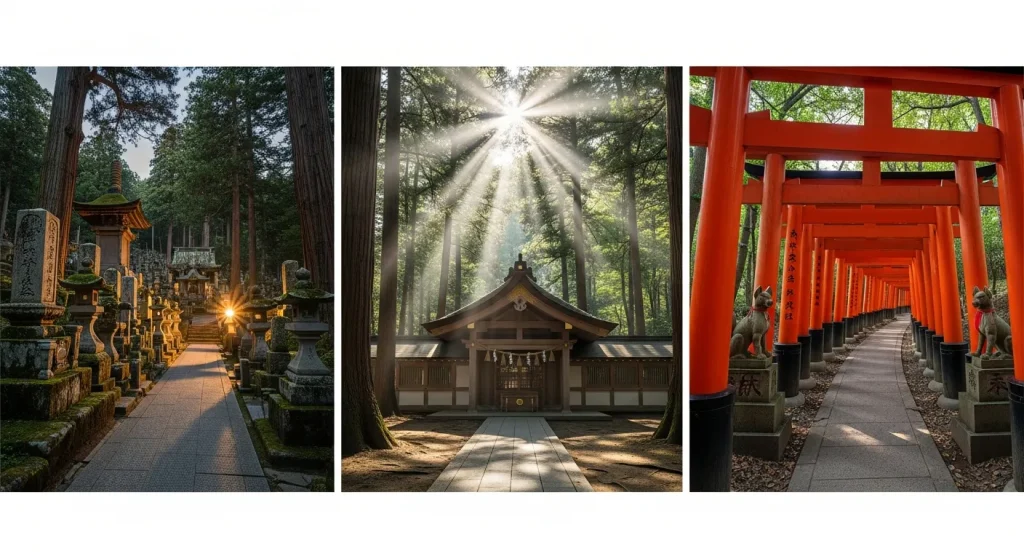
Candidate 1: Koyasan Okunoin – The Pinnacle of Buddhist Pilgrimage
If you view your Goshuin journey as a form of introspective training, the most fitting place to report its completion is Koyasan Okunoin, the sacred ground where Kobo Daishi (Kukai) is believed to still be in eternal meditation. As a universal “place of Mangan,” it connects your personal journey to the grand worldview of Buddhism. Reaching your final stamp here signifies not an end, but the beginning of a new cycle of practice, aligning your vows with Kobo Daishi’s eternal training.
Candidate 2: Toyokawa Inari – A Masterpiece of Syncretism
Modern Goshuin collecting often embodies the syncretic nature of Japanese faith, blending Shinto and Buddhist elements. Toyokawa Inari, a Soto Zen temple that is also a center of Inari worship, is an ideal place to embrace this diversity. It officially serves as the “Kechigan-ji” (final temple) for other pilgrimages, proving its track record as a non-denominational endpoint. It is a worthy place to conclude a Goshuin-cho filled with both the vibrant stamps of shrines and the solemn calligraphy of temples.
Final Proposal: Ise Jingu – The Spiritual Heart of Japan
Our ultimate recommendation is Ise Jingu (the Grand Shrine of Ise), which transcends sects and regions to stand as the highest authority for prayers for the peace and prosperity of all of Japan.
Ise Jingu, enshrining Amaterasu Omikami, the ancestral deity of the Imperial Family, is the spiritual home of the nation. It functions as a ‘womb’ that elevates personal gratitude and growth into a larger prayer for the community and ancestors. The act of bringing a Goshuin-cho filled with both shrine and temple stamps to the spiritual origin of Japan is, we conclude, the most comprehensive and solemn way to culminate a modern, diverse Goshuin pilgrimage.
The Mangan Ritual: What to Do at Your Final Destination

When you arrive at your final destination, it’s important to solidify your inner transformation through ritualistic acts.
– Receive Your Final Goshuin: This is not just a record; it is a seal of recognition from the divine that your journey is complete. Before receiving it, offer a silent prayer of thanks for a safe journey and for the guidance you received.
– Make Your Report (Hokoku): Report your experiences, the lessons you’ve learned, and your vows for the future to the deities. Use your own words, perhaps drawing inspiration from the “Words of Gratitude” below.
– The Afterlife of Your Goshuin-cho: A completed Goshuin-cho can be kept on a home altar (kamidana or butsudan) as a “testament to your life,” or it can be dedicated to a temple like Koyasan to make your prayers eternal. Both are meaningful choices that give form to your pilgrimage’s philosophy.
Drafted “Words of Gratitude” for the Divine

The true purpose of the “final chapter” is to convey your gratitude to the divine in the form of words (Kotodama). The following is a sample text for a report at a sacred site like Ise Jingu or Koyasan.
> Report of Pilgrimage Fulfillment (Mangan Hokoku)
>
> (After bowing, with head lowered, report silently in your heart or aloud.)
>
> To the revered gods of heaven and earth, to the buddhas of eternal compassion, and to all the ancestors who guided this journey, I humbly present this report of my pilgrimage’s fulfillment.
>
> First: Reflection and Gratitude for the Past Journey
> Over many months and years, I have traced these sacred footsteps. The trials along the way became my nourishment, and each Goshuin was a lantern in the dark. For the countless connections with gods and buddhas that fill this book, and for every precious encounter on this path, I offer my deepest gratitude.
>
> Second: Present Peace of Mind and Understanding
> Finishing this journey, I stand here now in a state of fulfilled tranquility. This Goshuin-cho is a testament to my heart’s purification and spiritual growth. By encountering diverse teachings, I have come to understand the deep inclusivity and spirit of harmony within Japanese faith. For this inner peace, I give my profound thanks.
>
> Third: A Vow for the Future—The Continuation of the Endless Journey
> This journey reaches its conclusion here. However, I know that the true “endless journey” lies in the spirit of gratitude, humility, and ceaseless practice that I have learned. I vow to carry the joy of this fulfillment into every corner of my daily life, to always be thankful for the blessings of heaven and earth, and to live with humility, purity, and integrity. I hereby declare that I will walk a new circle in the journey of life.
Conclusion: Living as an Eternal Pilgrim

Establishing a “final chapter” for your Goshuin pilgrimage and performing a Mangan ritual is a crucial process for cementing your spiritual growth. As the ultimate site for this final report, we strongly recommend Ise Jingu.
Though the physical pages of your book are full, your inner journey is never over. This completion is not a certificate of termination, but a rite of passage for your departure on the “next pilgrimage” called daily life. Your completed Goshuin-cho will become a compass to illuminate your future, and you will continue to walk through the bustle of the everyday as an eternal pilgrim.

コメント